Raft foundations are one of the most popular and effective types of foundations today, especially suitable for residential houses, townhouses and construction projects on weak or heterogeneous soil. Whether it is a house or a large project, the foundation always plays a decisive role in long-term durability and stability. Among foundation solutions, raft foundations (or comprehensive foundations, slab foundations) are favored by many investors and engineers thanks to their ability to distribute loads evenly and limit optimal settlement. This article will provide complete information about what a raft foundation is, its structure, advantages - disadvantages and technical standard construction process. Let's explore the details with S-House right here!
What is raft foundation?
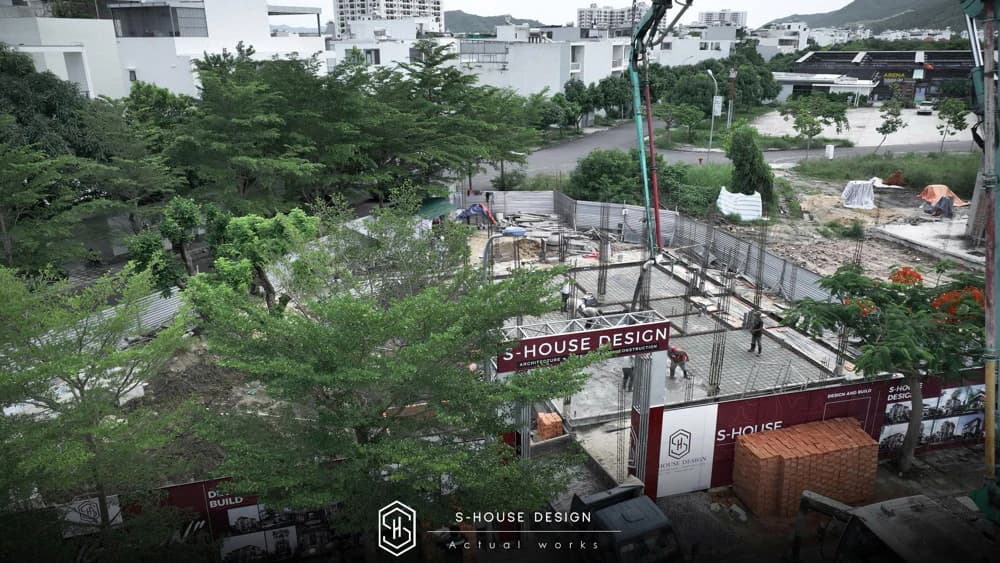
Raft foundation, also known as foundation, is understood as the technical construction structure located at the bottom of a construction project. Responsible for the function of loading the building's load onto the ground, helping the building withstand the pressure of the material blocks above as well as ensuring the safety of the entire building.
There are many types of construction foundations, each type will be suitable for each type of project such as single foundation, raft foundation, board foundation and pile foundation.
Raft foundations are called comprehensive foundations, are shallow foundations and are designed to be used mainly in places with weak ground, weak resistance whether with or without water, or due to the structural requirements of the building below such as basements, warehouses, toilets, tanks, swimming pools.
The working principle of the raft foundation is to use a large contact area to reduce the pressure on the ground. When the load from the column is transmitted down, the raft foundation will act as a rigid plate, distributing this force over a large area, helping the ground below bear the load more evenly and limiting local settlement.
This is considered a safe type of foundation and is widely applied because it is a safe and highly effective method of evenly distributing weight, helping to avoid subsidence. In particular, they are all developed into complete drawings for 2-story houses or similar.
See more: Quotation for full house construction
When should you choose the raft foundation solution?
Raft foundations are the optimal choice in the following cases:
+ Weak or uneven ground: When the good soil layer is too deep, or the ground has poor or uneven load-bearing capacity, raft foundations help distribute the load widely, reducing pressure on each point.
+ Construction load is relatively large and evenly distributed: Suitable for projects with many bearing columns close together or with load-bearing walls.
+ Buildings with basements: Raft foundations are often combined as basement floors, helping to save costs and optimize space.
+ Limit differential settlement: With its stiffness, raft foundations help minimize differential settlement between parts of the building.
+ Favorable construction conditions for shallow foundations: When you do not want or cannot construct deep foundations such as pile foundations.
See more: What are the rough and finished parts of building a house? item details from S-House
Detailed structure of raft foundation
A typical raft foundation system includes the following main components:
Concrete lining layer (4×6 stone concrete or 1×2 stone, grade 100-150):
+ About 100mm thick.
+ Effect: Flattens the surface, creates a clean separation layer, prevents cement dehydration for the main foundation concrete layer, and limits erosion from groundwater.
Foundation slab (Foundation floor):
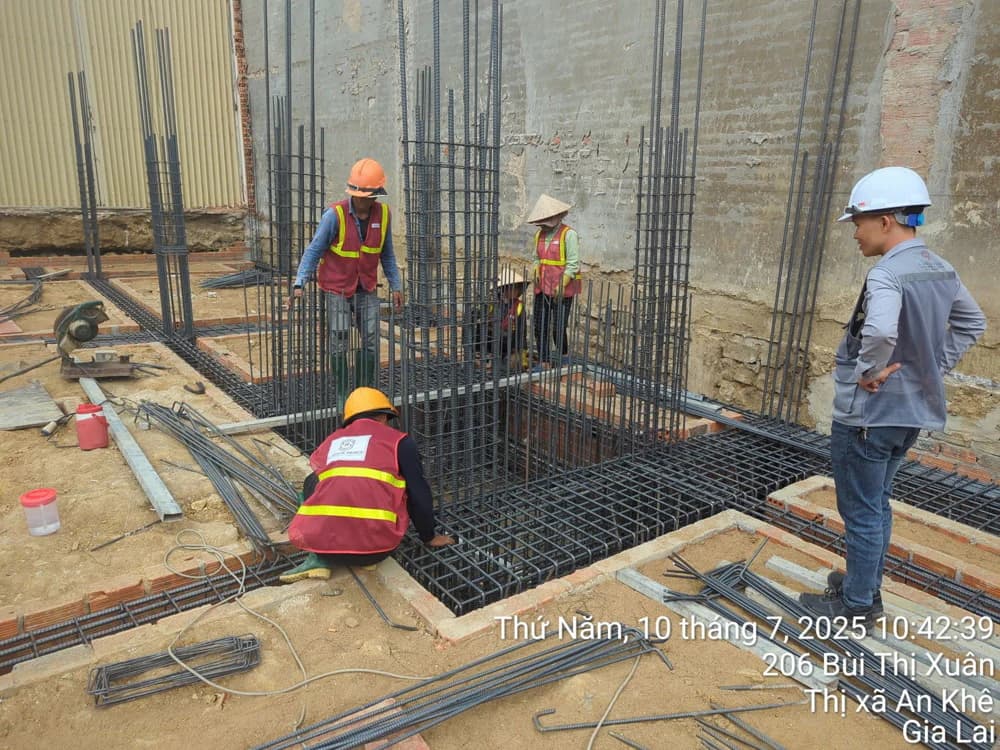
+ Is a large reinforced concrete slab, usually with a thickness of 200mm or more.
+ Reinforcement: Usually arranged in two layers (top and bottom).
+ Lower steel layer: Resists the positive moment due to the upward reaction force of the soil (when the entire house presses down, the soil will react back). This is the main load-bearing steel layer for the foundation slab.
+ Upper steel layer: Resists negative moments, often appearing in the area near the column or due to other factors.
+ Steel weaving distance is usually a100, a120, a150, a200 depending on calculation.
Foundation beam (Reinforced rib):
+ Are reinforced concrete beams running in the direction of columns or walls, or arranged in an orthogonal grid on the foundation slab.
+ Effect: Increases the stiffness of the entire raft foundation, helps distribute the load from the column to the foundation slab more effectively, and withstands large bending moments.
+ Reinforcing foundation beams usually have large diameters and large quantities (for example, 4-6-10 bars of Φ18, Φ20, Φ22 depending on the load).
Steel for columns/walls:
+ Firmly connected to the foundation steel system, ensuring continuous force transmission from the above structure to the foundation.
+ The steel leg waiting for the column needs to be bent (flexor leg) to firmly anchor it to the foundation concrete.
Millet (Concrete or plastic millet):
+ Ensure the thickness of the concrete layer protects the steel reinforcement, prevents the steel from rusting and ensures the steel works in the correct design position.
Advantages of raft foundations
+ Evenly distribute load: Reduce pressure on the ground, suitable for weak ground.
+ Minimize differential settlement: The overall stiffness of the raft foundation helps the project settle more evenly.
+ Relatively simple construction: Compared to complex deep foundations.
+ Utilize as basement floor: Optimize function and cost.
+ Easy to construct: Experienced builders can do it well.
Disadvantages of raft foundations
+ Large material costs: Costs more concrete and reinforcement than some other types of shallow foundations for the same scale.
+ Foundation burying depth can be large: To ensure sufficient rigidity and avoid overturning and slipping.
+ Not suitable for too large loads or too weak ground: Then deep foundation solutions such as pile foundations are needed.
+ Sensitive to sudden changes in the ground: If there is a local area of weak soil that is not treated.
Golden notes and mistakes to avoid when constructing raft foundations
Construction of raft foundations requires caution and compliance with proper techniques. Here are the key points:
+ Soil work and leveling the bottom of the foundation: This is an extremely important factor. An uneven foundation bottom will cause the foundation to make uneven contact, causing stress concentration and uneven settlement.
+ Ensure the rigidity of the raft foundation: The amount of steel and size of the foundation beam must be calculated sufficiently. A foundation that is not strong enough will not be able to distribute the load evenly, leading to local deformation and cracking under the column locations.
+ The lower layer steel is the most important: Must ensure sufficient quantity, diameter and arrangement as designed because this is the layer that withstands the main reaction force from the soil.
+ Appropriate depth of burying the foundation: The depth of burying the foundation must be sufficient to avoid slipping or overturning, especially for projects with horizontal loads or on sloping ground.
+ Do not confuse the working principle: Experience in constructing strip foundations cannot be applied to raft foundations by lengthening steel. The two types of nails have different working principles.
+ Mistake when driving reinforcing piles arbitrarily under the raft foundation: Adding piles under the raft foundation without synchronous design calculations can cause local failure of the raft foundation structure due to the concentration of load on the pile head.
+ Correctly evaluate the load-bearing capacity of the ground: Even if the raft foundation is designed to be very hard, if the ground is not capable of bearing the load (for example, the soil can bear 3 tons/m² but the structure exerts a pressure of 4 tons/m²), the entire foundation will still sink.
+ Steel for columns and connections: Steel for columns must have enough anchor length, be bent and securely connected to the foundation steel.
+ Protective concrete layer: Use standard spacers to ensure the reinforcement is not exposed and avoid rust.
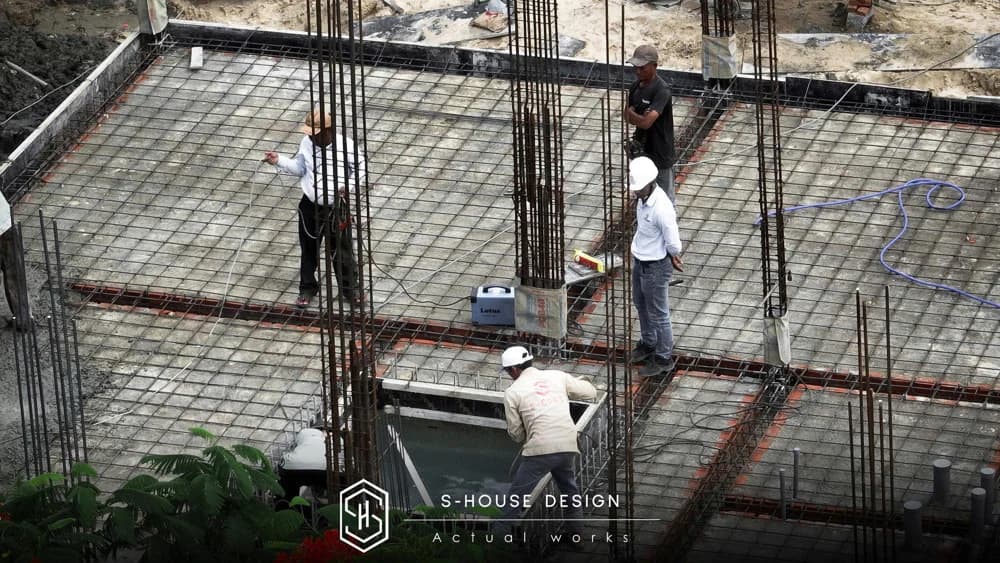
Understanding raft foundations and their complex engineering is essential
S-House – Accompanying you to build a solid foundation
Understanding what a raft foundation is and its complex technical requirements is essential. However, to ensure a truly safe and sustainable foundation, choosing a professional and experienced design and construction unit is extremely important. At S-House, we commit to:
+ Consulting on optimal foundation solutions based on actual geological surveys
+ Accurate design, complete calculations
+ Standard construction process, closely monitoring each stage
+ Transparency of costs and progress
If you are learning about raft foundations or need advice on house construction, do not hesitate to contact S-House for the most dedicated and professional support.
>>> See more: Full villa design and construction company S-House
If you need advice on villa design, please contact us immediately hotline 0866 006 060 or leave information via: https://nhadepshouse.com/nhan-mau-thiet-ke/ S-House will quickly contact you within 24 hours.
------------------------------
S-House Joint Stock Company - Unit ARCHITECTURAL - INTERIOR DESIGN AND CONSTRUCTION has developed strongly with a system of 4 strategic branches stretching from North to South. Confident in being a reputable and quality architectural and interior design and construction company in terms of project quantity and quality. Our team of experienced architects not only builds houses, but also creates living works of art. Let S-House turn your ideas into reality today!
Hotline: 0866 006 060
E-mail: nhadepshouse@gmail.com
Branch system nationwide:
► In the city. HCM: No. 280A1, Luong Dinh Cua Street, An Phu Ward, District 2, Ho Chi Minh City
► In Nha Trang: No. 62A - 62B, Phan Chu Trinh Street, Van Thanh Ward, City. Nha Trang, Khanh Hoa
► In the city. Vinh: No. 19, An Duong Vuong Street, Truong Thi Ward, City. Vinh, Nghe An
► In Hanoi: D49-01 LK7 Geleximco Le Trong Tan, Ward Duong Noi, Hanoi


